
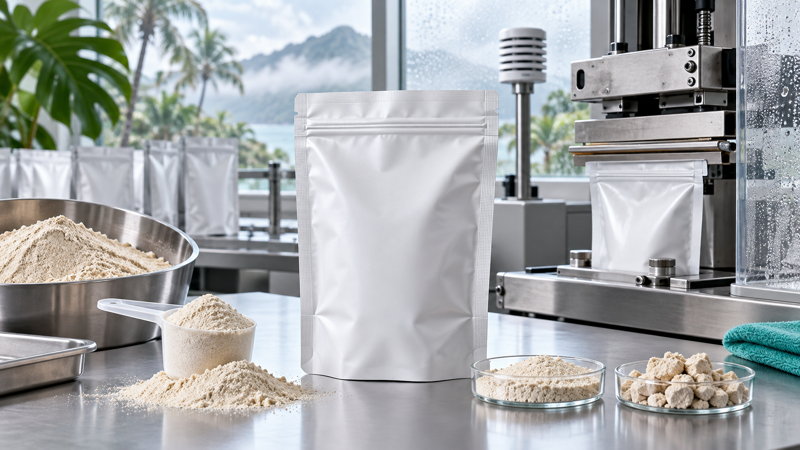
Protein powder packaging faces a much harder test in humid climates than it does in a controlled laboratory. Moisture can enter through the film, seals, zipper, or repeated consumer opening. The powder may then form lumps, lose flowability, stick to a scoop, or develop an unacceptable appearance before the declared shelf life ends. At the same time, airborne powder can contaminate the seal during packing and create a leak path that accelerates the problem.
Preventing caking is not a matter of selecting a foil-looking pouch and adding a desiccant. The product formulation, initial moisture, package barrier, filling process, seal integrity, closure design, distribution climate, and consumer use period all contribute. A dependable solution controls each path rather than relying on a single component.
Understand Why Protein Powder Cakes
Many protein and nutrition powders contain ingredients that readily absorb moisture from surrounding air. Sweeteners, flavors, mineral blends, plant proteins, dairy proteins, and functional ingredients can change the product’s moisture sensitivity. Fine particles also provide a large surface area for moisture interaction.
Caking may begin as small soft agglomerates and progress into hard masses. The powder can still be chemically acceptable while consumers interpret the texture as stale or defective. Severe moisture exposure can also affect flavor, color, nutrient stability, and microbiological risk, depending on the formulation.
Start with product data. Measure water activity, moisture content, bulk density, particle size, and hygroscopic behavior. Determine the humidity at which the powder begins to lose acceptable flow or form persistent lumps. This critical condition helps packaging engineers model how much moisture the package can tolerate over its full life.
Design for the Real Climate and Use Period
A shelf-life claim should cover more than the sealed warehouse stage. The package may be filled in one climate, shipped through a hot port, stored in an unconditioned distribution center, displayed in retail, and opened daily in a humid kitchen or gym.
Define temperature and relative-humidity profiles for the target markets. High temperature can increase permeation and accelerate ingredient changes. Daily temperature cycling may create pressure changes or condensation risks when packages move between air-conditioned and outdoor environments.
The opened-use period is especially important for large pouches. Every opening replaces part of the headspace with humid air. Even a good zipper cannot undo that exposure. Pack size should match realistic consumption so the consumer finishes the product before cumulative moisture becomes unacceptable.
Choose the Barrier as a Complete Structure
Protein powder pouches typically need strong moisture protection as well as oxygen, aroma, and light control. The relevant performance is the water-vapor transmission rate of the complete structure under conditions related to the target climate. Test method, temperature, humidity gradient, and units must be compared carefully when reviewing supplier data.
Foil stand-up pouches can provide excellent moisture and oxygen barrier when the foil layer remains free from pinholes and flex damage. Metallized films may offer good barrier with different cost and durability characteristics. Transparent high-barrier structures can support product visibility, but their actual performance must meet the shelf-life calculation.
Thickness alone does not define protection. Layer selection, adhesive quality, converting conditions, seals, zipper integration, and package geometry all matter. The practical guidance on choosing barrier material for protein powder should be connected to product sensitivity and validation data rather than a material name alone.
Prevent Powder From Entering the Seal
Fine protein powder can remain suspended after dosing and settle on the pouch’s sealing surface. Particles trapped between sealant layers interrupt contact, create channels, and reduce peel strength. A package may pass a casual visual check yet allow moisture ingress through a microscopic pathway.
Control begins at the filler. Optimize the dosing cut-off, drop height, funnel shape, settling time, dust extraction, and pouch movement. Avoid a sudden air pulse that blows powder upward. If the product bridges or releases inconsistently, correct flow at the dosing system rather than compensating with excessive vibration.
Keep the fill level comfortably below the zipper and top seal. Wipe or air-cleaning systems must be validated so they remove powder without contaminating the product or spreading dust around the line. A wider seal can add tolerance, but only when the surface is sufficiently clean.
Select a sealant with appropriate hot tack and contamination tolerance. Establish a process window for temperature, pressure, and dwell time at actual line speed. Inspect seals for wrinkles, channels, burn-through, distorted zipper flanges, and product particles.
Treat the Zipper as a Moisture-Control Component
A zipper makes a large pouch usable, but powder caught in the profile can prevent complete reclosure. Consumers may run their fingers across the top and believe it is shut even when one section remains open.
Choose a zipper profile that is easy to align and close. Test it after repeated cycles with powder deliberately introduced around the track. Evaluate whether the user can see, hear, or feel closure. The pouch should provide enough headspace for a scoop without forcing the consumer to touch the zipper with powder-coated hands.
The initial heat seal above the zipper provides tamper evidence and protects the unopened product. Position tear notches so the consumer does not cut into the zipper. Leave sufficient grip area, especially on large formats where a stiff laminate can be difficult to tear.
Reseal instructions can help, but design should carry most of the burden. Simple language such as removing powder from the zipper and pressing it closed across the full width is more useful than a vague request to store in a cool, dry place.
Decide Whether to Use a Desiccant
A desiccant can absorb a defined amount of moisture in the package headspace and moisture entering over time. It is not a substitute for low-barrier film or a leaking seal. If the moisture load exceeds its capacity, protection ends.
Calculate the required capacity from residual headspace humidity, product moisture behavior, package transmission, expected shelf life, and opening pattern. Choose a food-appropriate format and verify compliance for the intended market. The sachet or canister must be clearly distinguishable from the product and should not interfere with scooping.
Consider how the desiccant moves during shipping. A loose sachet can settle deep in the powder or be removed unintentionally with a scoop. A fixed or integrated approach may improve control but introduces manufacturing and recycling considerations.
Validate the complete design with and without foreseeable consumer misuse. If performance collapses after a few zipper openings, increasing desiccant alone is unlikely to create a robust package.
Size the Pouch for Product and Scoop
Powder bulk density can vary between flavors and lots. Fill representative formulas into candidate pouches and allow them to settle before assessing fill height. Too little headspace makes sealing and scooping difficult; too much creates an underfilled appearance, excess material, and a larger moisture-containing headspace.
Large-format supplement pouches should support the complete dosing routine. Confirm that the pouch opening admits the selected scoop, that the consumer can reach the bottom without coating the zipper, and that the bag remains stable as product is removed.
Validate Shelf Life and Distribution
Accelerated barrier calculations are useful for screening, but real-time product testing remains essential. Pack production-equivalent powder on the intended line, condition samples under target and challenging climates, and track moisture, water activity, flow, caking, flavor, color, nutrient markers, seal strength, and package appearance.
Include repeated-opening studies that simulate actual daily use. Open the pouch for a consistent period, remove product, expose it to controlled humidity, clean or do not clean the zipper according to the study plan, and reclose it. This often reveals risks that sealed-package testing misses.
Production and Quality Controls
Control room humidity where practical, and minimize the time powder and open pouches remain exposed. Verify incoming film structure, thickness, appearance, zipper alignment, and sealability. During production, monitor fill weight, seal contamination, seal strength, leak performance, and code legibility.
Retain samples by lot and record climate-related complaints with enough detail to identify patterns. “Clumpy powder” should be connected to formulation, fill date, packaging lot, seal settings, route, storage, and time after opening. Good traceability turns a subjective complaint into useful improvement data.
Humid-Climate Packaging Checklist
- Define product moisture sensitivity and the humidity at which caking begins.
- Model sealed storage, distribution, and repeated consumer opening.
- Select a laminate using relevant moisture-barrier data and package testing.
- Keep powder away from zipper tracks and heat-seal surfaces.
- Validate the full sealing window at normal production speed.
- Size the pouch for realistic bulk density, scoop access, and use period.
- Use desiccant only after calculating the moisture load and placement risks.
- Run real-time, accelerated, repeated-opening, and distribution studies.
Protein powder packaging for humid climates succeeds when moisture has no easy route into the product. Strong film barrier is important, but clean seals, reliable reclosure, appropriate pack size, and disciplined validation are equally necessary. Designing around the real market and consumer routine protects flowability, confidence, and shelf life long after the pouch leaves the filling line.