
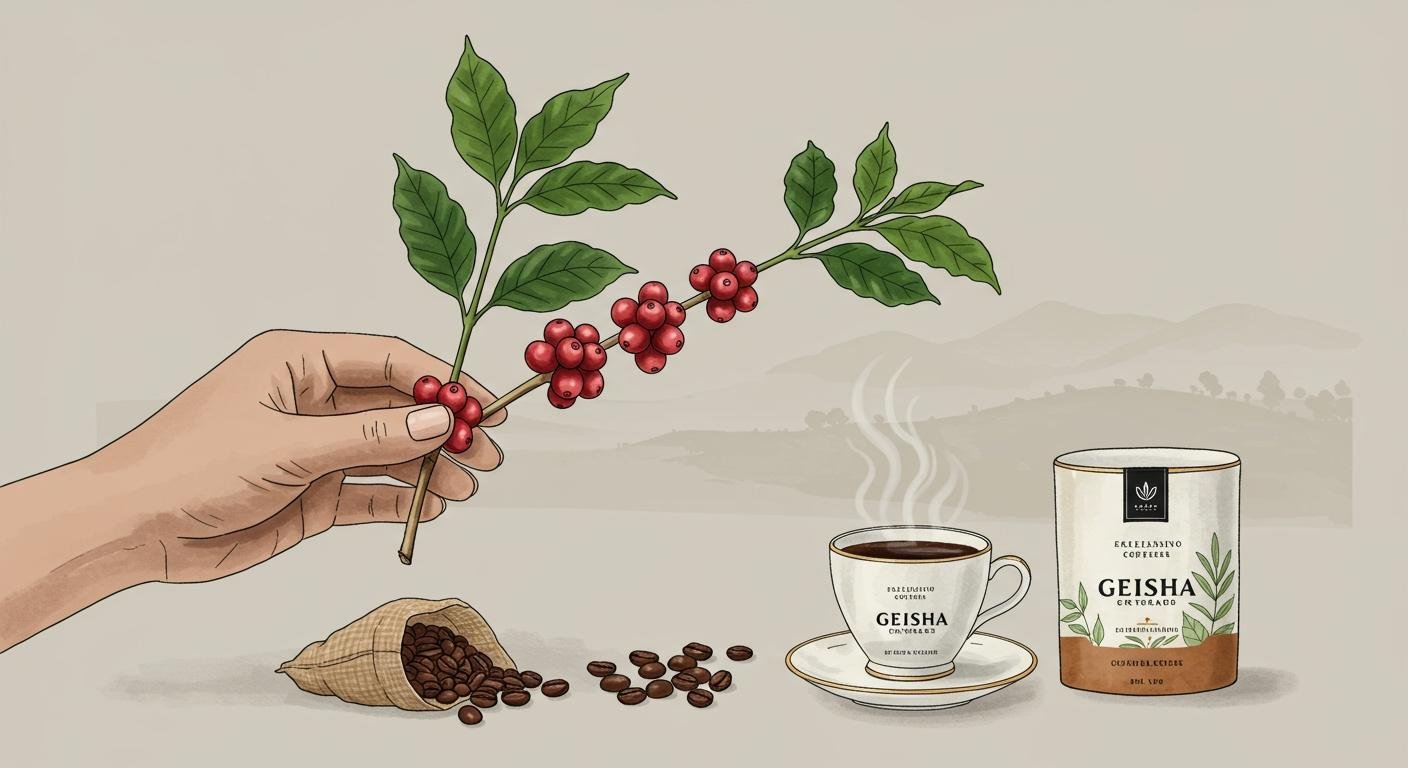
Geisha coffee stands as the world’s most coveted bean, earning record-breaking prices at international auctions. You can see its value in the table below, where a single pound reached $1,029 at the Best of Panama auction.
Competition/Auction | Year | Price/Score | Notes |
|---|---|---|---|
Best of Panama | 2004 | $21/pound | Record price for Geisha |
Best of Panama | 2019 | $1,029/pound | Highest auction price |
World Barista Championship | 2016 | N/A | Champion used Geisha |
World Brewers Cup | Last 4 years | N/A | All winners used Geisha |
You experience intense floral aromas, delicate tea-like body, and lingering sweetness in every cup. This sought-after coffee variety delivers exceptional quality, making careful packaging essential for preserving freshness. BN PACK’s custom coffee bags help keep these rare beans at their best.
Geisha Coffee Origins
Ethiopian Beginnings
You discover the roots of gesha in the lush forests of Ethiopia. The journey starts in the early 20th century, when explorers and agronomists searched for new coffee varieties.
British colonial agronomists collected seeds from the Gesha region in the 1930s.
These seeds traveled to research stations across Africa and Latin America.
The gesha varietal was first identified in the Gori Gesha forest, known for its rich biodiversity.
Researchers sent seeds to Tanzania and Kenya, hoping to find disease-resistant plants.
The variety was registered as ‘Geisha’ in the 1950s and later sent to Costa Rica.
Noboru Ueno, a respected coffee professional, reminds you that every country should honor the original culture. He encourages you to use the correct term “gesha” to respect its Ethiopian heritage.
You see that gesha developed naturally over generations, making it a true Ethiopian landrace. This history gives the coffee its unique genetic makeup and flavor potential.
Rise in Panama
You follow the path of gesha as it reaches Panama.
In 1963, Pachi Serracin introduced gesha seeds to Panama, planting them in Boquete’s volcanic soil.
Farmers saw gesha as a curiosity because of its low yields and fragile nature.
Daniel Peterson discovered a special cluster of gesha trees in 2003. He submitted the coffee to the Best of Panama competition.
The coffee won the competition, changing its reputation overnight.
The introduction of geisha coffee to Panama aimed to fight coffee leaf rust. You notice that its recognition did not come until 2005, when it won awards and transformed the coffee landscape.
The success of gesha coffee since 2004 inspired farmers in other regions to grow this variety. You witness a global appreciation for its unique flavor profile.
Global Spread
You watch as gesha gains worldwide fame.
The coffee’s reputation soared, attracting specialty coffee enthusiasts everywhere.
It won awards in global competitions, boosting its prestige.
Farmers in Colombia, Costa Rica, and other countries began cultivating gesha on specialized farms.
The coffee broke auction records in 2005, selling for over $20 per pound.
Genetic diversity analyses confirmed its unique genetics and high cup quality.
The remarkable flavor profile, with floral and fruity aromas, drew international attention.
David Inoue, a leader in the coffee community, points out that using “Geisha” to market Ethiopian coffee can be misleading. He urges you to respect the origins and avoid exoticizing the name.
You realize that gesha coffee now stands as a symbol of excellence. Specialized farms around the world strive to produce beans that match the legendary quality first discovered in Panama.
Geisha Coffee Characteristics

Flavor Profile
You experience a flavor profile in geisha coffee that stands apart from other beans. When you brew this special varietal, you notice bright jasmine aromatics and distinct floral notes that fill the air. The first sip reveals intense flavors, including tropical fruit flavors like mango and papaya. You taste a delicate sweetness balanced by lively acidity.
A scientific study on Panama Geisha coffee shows how roasting methods change the flavor profile. Treatments A and B bring out floral and bergamot notes, while treatment E highlights citrus flavors. Researchers use gas chromatography-mass spectrometry to analyze the aroma components, showing that different roasting techniques create significant changes in sensory attributes.
You find that the flavor profile of geisha coffee includes layers of flavors such as honey, bergamot, and stone fruit. The distinctive flavor and aroma make this varietal a favorite in the specialty coffee world.
Tip: You can enhance the flavor profile by experimenting with different brewing methods and roast levels.
Physical Traits
You recognize geisha coffee beans by their unique physical traits.
Geisha coffee beans have a relatively low yield compared to other Arabica varieties.
The average bean size matches other Arabica types, but you notice the outstanding flavor potential in each bean.
Geisha stands out as a significant varietal in the specialty coffee market.
You see that the beans have a long, slender shape. The green coffee beans often show a bluish tint before roasting. These physical traits help you identify geisha coffee among other specialty beans.
Cultivation
You learn that cultivating geisha coffee requires careful attention and specific conditions.
Geisha coffee thrives in high-altitude areas, where cooler temperatures and slower maturation enhance the complex flavors and flavor profile.
You need stable montane growing conditions to produce high-quality beans.
The meticulous care needed for this special varietal is labor-intensive and costly.
You face challenges from climate change, which threatens the specialty coffee industry. Unpredictable weather, droughts, and fluctuating temperatures can reduce yields and affect the flavor profile. Experts predict that suitable land for coffee cultivation may decrease by 2050. You must adapt to these changes to maintain the quality of geisha coffee beans.
Note: You can support sustainable farming practices to help protect geisha coffee and other specialty varietals for future generations.
Gesha Rarity and Value
Limited Production
You find that gesha coffee remains rare because only a few regions can grow it successfully. Panama, Colombia, and Ethiopia offer the right climate and soil for this unique bean. Farmers must work with trees that yield fewer cherries than other varieties. You see that the limited supply comes from both the small harvest and the strict growing conditions. High demand from coffee lovers around the world makes gesha even harder to find. This combination of low supply and high demand drives up the price and adds to its mystique.
Gesha trees yield fewer cherries than most coffee plants.
Only select regions with special climates can produce high-quality gesha.
The restricted supply increases the value of each harvest.
Auction Prices
You notice that gesha coffee often breaks records at auctions. The best of panama competition sets the stage for these high prices. In 2025, a washed gesha from Hacienda La Esmeralda sold for $30,204 per kilogram, making headlines worldwide.
Coffee Type | Auction Price (USD) |
|---|---|
Elida Geisha Natural | $1,029 per pound (2019) |
Honey-processed Geisha | $13,518 per kilogram (2024) |
Carmen Estate Geisha | $10,005 per kilogram |
Hacienda La Esmeralda | $30,204 per kilogram (2025) |
Finca Sophia | $10,020 per kilogram |
Kona SL 34 | $910 per kilogram |
Finca La Mula | $2,620 per kilogram |
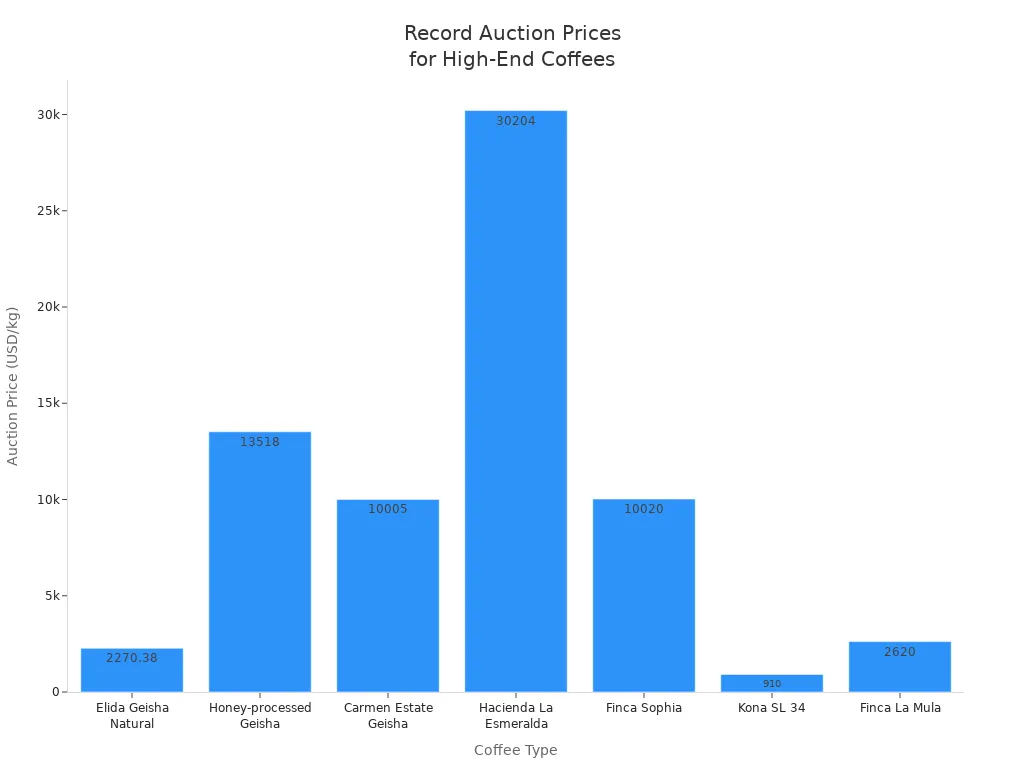
You see that gesha coffee outperforms other high-end coffees at auction. The price reflects its rarity and the excitement it brings to the specialty coffee market.
The 2025 Best of Panama auction saw a washed Geisha from Hacienda La Esmeralda sell for an unprecedented $30,204 per kilogram, highlighting the global demand for this luxury coffee.
Prestige
You understand that owning or serving gesha coffee signals prestige. Many companies buy this coffee to boost their brand identity and attract customers who seek rare experiences. The marketing value of offering such a special product draws attention from both local and international markets. You see that the success of gesha in Panama has inspired farmers in Colombia and El Salvador to invest in similar plantations. The reputation of this coffee continues to shape the global market, making it a symbol of excellence and luxury.
Coffee Packaging by BN PACK
Custom Coffee Bags
You want your coffee to stand out and stay fresh. BN PACK offers custom coffee bags designed for specialty beans like Geisha. You can choose from flat bottom, stand-up, or side gusset styles. Each bag uses high-barrier materials to protect your coffee from moisture, oxygen, and light. You select the size and finish that matches your brand. Advanced digital printing lets you create eye-catching designs. You also benefit from features like resealable zippers and one-way degassing valves, which help maintain the integrity of your coffee.
Tip: Custom coffee bags with degassing valves keep your beans fresh by letting out carbon dioxide while blocking air and moisture.
Features and Benefits
You get more than just packaging. BN PACK’s coffee bags offer several advantages:
Maintains freshness and prevents oxidation
Extends shelf life by 30-60%
Enhances consumer perception of quality and freshness
Optimizes warehouse and distribution efficiencies
You also notice practical benefits:
Increased stacking height for better storage
Reduced space requirements by eliminating degassing areas
Simplified inventory management without tracking degassing status
Improved worker safety due to stable stacks
Lower handling costs from reduced reworking
You see how BN PACK’s innovations set them apart. The table below highlights key features compared to industry standards:
Feature | BN PACK Solutions | Industry Standards |
|---|---|---|
Airtight Seal | DualGuard Coffee Bag with dual zipper | Conventional single-zipper designs |
Degassing | One-way degassing valves | Limited or no degassing capabilities |
Shelf Life Extension | Up to 30% longer shelf life | Varies, often shorter |
Sustainability | EcoLock series with biodegradable materials | Traditional plastic packaging |
Biodegradability | HempGuard line with hemp-based composites | Limited options for biodegradability |
Eco-Friendly Solutions
You care about sustainability. BN PACK provides eco-friendly packaging options for coffee brands. You can choose kraft paper, which is recyclable, biodegradable, and compostable. Rice paper uses renewable bamboo and has minimal environmental impact. LDPE is 100% recyclable and reduces energy use. PLA breaks down in composting conditions within 90 days. Water-based inks with low VOCs make recycling easier and safer for the environment.
Note: Eco-friendly coffee bags help you support global sustainability goals and appeal to environmentally conscious customers.
Geisha Coffee Experience
Tasting Notes
When you taste geisha coffee for the first time, you often feel surprised by its complexity. Many people describe the experience as a revelation. You notice how the flavors change with each sip. The journey starts with bright floral notes, like jasmine or rose. As you continue, you pick up hints of citrus, such as lemon or bergamot. The finish brings out sweet, fruity flavors, including mango or peach.
You may find that the coffee feels light and silky on your tongue. The aroma fills the air, making the tasting feel special. Most people say that geisha coffee stands out from other varieties because of its depth and clarity. You do not just drink a cup; you enjoy an artisanal experience that takes you on a sensory journey.
Tip: Slow down and pay attention to each flavor as it appears. This helps you appreciate the full range of notes in every cup.
Brewing Tips
You can bring out the best in geisha coffee by choosing the right brewing method. Each method highlights different qualities of the beans. Here are some popular ways to brew:
Chemex: This method gives you a silky smooth cup. It brings out floral notes and bright acidity.
Pour-over (V60): You control the brewing process. This lets you showcase complex flavors and keep the cup balanced.
AeroPress: You can experiment with recipes. This method helps you discover unique flavors in each batch.
French Press: This adds body and texture. It emphasizes the fruitier and richer flavors in the coffee.
You may notice that competitions and awards also shape the reputation of geisha coffee. The table below shows how these events impact its status:
Evidence Description | Impact on Reputation |
|---|---|
Winning the ‘Best of Panama’ competition highlights the exceptional quality of Geisha Coffee. | Elevates the perception of Panamanian coffee globally. |
High scores in competitions reflect the dedication of producers. | Solidifies Geisha Coffee’s status as a luxury product. |
The Elida Geisha Natural coffee scored 95.13 in the competition. | Demonstrates the high demand and quality of Geisha Coffee. |
Recognition of individual lots contributes to the overall reputation of Panamanian coffee. | Shows the country’s commitment to high-quality specialty coffee. |
Note: Try different brewing methods to find the one that matches your taste. Each method offers a new way to enjoy this artisanal experience.
You see why Geisha Coffee stands out. Its unique origins, rare characteristics, and high market value make it a true treasure. Premium packaging plays a key role in preserving quality and boosting brand appeal.
Strong barriers protect flavor and aroma from oxygen, moisture, and light.
Features like degassing valves and user-friendly designs help your brand shine.
The specialty coffee market keeps growing as more people seek high-quality, ethically sourced beans. You can enjoy both the artistry of Geisha Coffee and the innovation in packaging that keeps every cup special.