

Why do so many people reach for a cup of coffee without the buzz? Decaf coffee beans are created by removing caffeine from green coffee beans through scientific processes that try to keep the original flavor. About 12% of coffee drinkers worldwide choose decaf instead of regular coffee, showing that it has a dedicated following. Great packaging, like that from BN PACK, helps keep decaf coffee beans fresh and flavorful for every cup.
Why Decaf Coffee Beans
Health Reasons
Many people choose decaf coffee beans for health reasons. Some want to avoid the side effects of caffeine, like jitters or trouble sleeping. Others need to limit caffeine because of medical conditions. Decaf coffee beans let them enjoy the taste of coffee without the buzz.
Did you know? Decaf coffee still contains antioxidants that help support heart and brain health. Scientific studies show that both regular and decaf coffee can lower the risk of diseases like Type 2 diabetes and heart disease. People who are sensitive to caffeine often find that decaf gives them the benefits of coffee without causing anxiety or restlessness.
Here’s a quick look at how decaf compares to regular coffee:
Health Aspect | Decaf Coffee Beans | Regular Coffee |
|---|---|---|
Heart Health | May reduce heart-related risks, similar to regular coffee | May reduce risks |
Mental Health | Can improve mood and reduce anxiety, without caffeine side effects | Can improve mood |
Sleep Quality | Less likely to disturb sleep | May cause sleep issues |
Caffeine Sensitivity | Good for those who react badly to caffeine | Not suitable |
Consumer Demand
Consumer demand for decaf coffee beans has grown a lot in recent years. People of all ages, especially younger ones like Millennials and Gen Z, want to cut back on caffeine. They care about better sleep, less stress, and avoiding caffeine dependency.
Many choose decaf to enjoy coffee at any time of day without worrying about staying awake at night.
Improved decaf processing means the flavor and aroma are better than ever.
Specialty coffee shops and supermarkets now offer more high-quality decaf options.
The rise of wellness trends and the popularity of no/low alcohol drinks have made decaf more mainstream.
During the COVID-19 pandemic, more people started drinking decaf at home, boosting its popularity.
Decaf coffee beans now appeal to a wide range of people, not just those with health concerns. The market keeps growing as more consumers look for ways to enjoy coffee without the caffeine.
Decaffeination Science
Caffeine Solubility
Caffeine is a small, water-soluble molecule. This property makes it possible to remove caffeine from coffee beans using different liquids. The way caffeine dissolves in water or other solvents shapes how each decaffeination method works. When green coffee beans soak in hot water, caffeine leaves the beans and enters the water. The Swiss Water Process uses this idea, pulling caffeine out while trying to keep the flavor inside the beans.
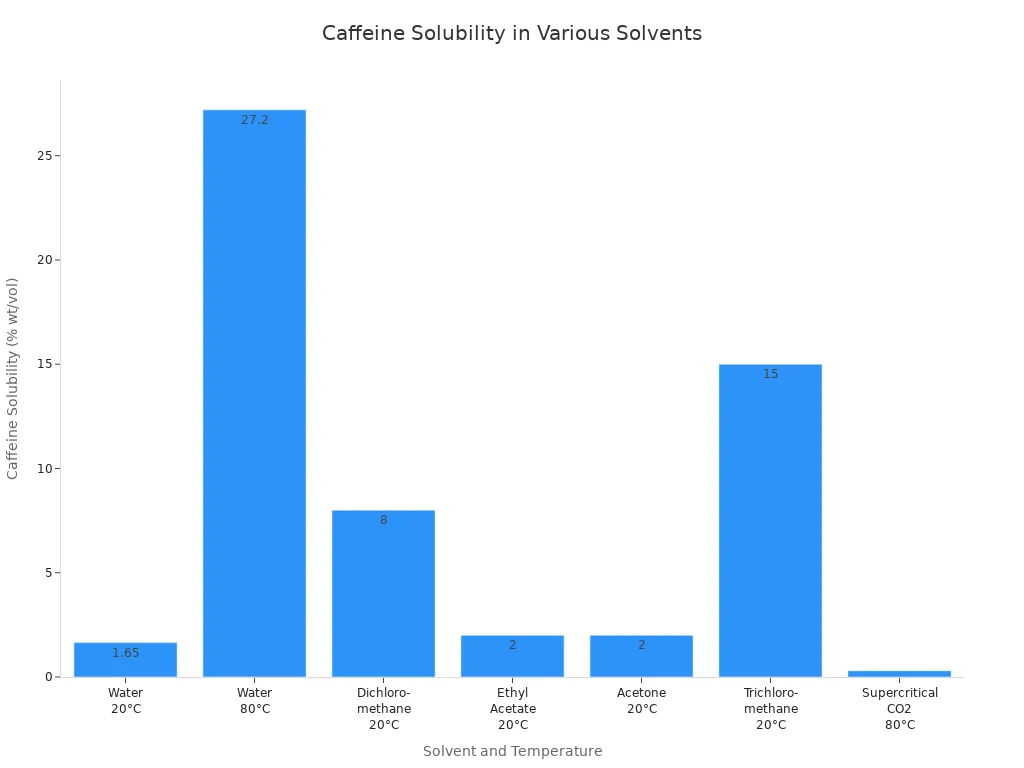
The solubility of caffeine changes with temperature and the type of solvent. Hot water dissolves caffeine much faster than cold water. Organic solvents like methylene chloride and ethyl acetate can also grab caffeine from the beans, even at lower temperatures. Supercritical CO2, which is carbon dioxide under high pressure and temperature, acts like both a gas and a liquid. It can pull caffeine out with high selectivity, leaving most flavors behind.
Here’s a quick look at how caffeine dissolves in different solvents:
Solvent | Temperature (°C) | Approximate Caffeine Solubility (% wt/vol) |
|---|---|---|
Water | 20 | ~1.65 |
Water | 80 | ~27.2 |
Dichloromethane | 20 | ~8 |
Ethyl Acetate | 20 | ~2 |
Acetone | 20 | ~2 |
Trichloromethane | 20 | ~15 |
Supercritical CO2 | ~80 | ~0.3 |
Tip: The hotter the water, the more caffeine it can dissolve. That’s why decaffeination often uses heat.
The choice of solvent and temperature affects how much caffeine comes out and how much flavor stays in. For example, the Swiss Water Process uses hot water and activated charcoal to filter out caffeine, while keeping the taste. Solvent-based methods use chemicals that bond with caffeine, pulling it out without taking too many flavor compounds. Supercritical CO2 works under pressure, removing caffeine with little impact on taste.
Here’s a table showing the science behind each main extraction method:
Extraction Method | Scientific Principle(s) | Solvent(s) Used | Key Notes |
|---|---|---|---|
Swiss Water Process | Simple diffusion driven by concentration gradients; caffeine is polar and water-soluble | Water | Beans soaked in water; caffeine filtered out by activated carbon; flavor preserved; no chemicals used |
Ethyl Acetate Processing | Solvent polarity matching (‘like dissolves like’); caffeine binds to polar ethyl acetate molecules | Ethyl acetate (polar organic solvent) | Beans steamed to swell; single-step extraction; ~97% caffeine removal; less health/environmental hazard |
Methylene Chloride Processing | Hydrogen bonding between caffeine and solvent; selective solubility | Methylene chloride (polar organic solvent) | Direct: solvent rinses beans; Indirect: water soak then solvent extraction; ~97% caffeine removal |
Supercritical CO2 Extraction | Supercritical fluid extraction; selective solubility and diffusivity of caffeine in supercritical CO2 | Supercritical CO2 (with cosolvents like ethanol or water) | Environmentally friendly; moderate extraction times; selective caffeine removal; some co-extraction issues |
Extraction Challenges
Removing caffeine from coffee beans sounds simple, but the process faces many technical hurdles. Each method must balance pulling out caffeine with keeping the rich flavors that coffee lovers expect. Here are some of the main challenges:
Aqueous extraction, like the Swiss Water Process, takes a long time. This can slow down production.
Solvent-based methods risk removing aroma and flavor compounds along with caffeine. They also need careful control to avoid leaving any solvent behind.
Supercritical CO2 extraction works well but costs a lot because of the high-pressure equipment.
The way caffeine moves out of the beans depends on temperature, bean type, and how much moisture is inside. Roasted beans release caffeine faster than raw beans, especially at lower temperatures.
The process needs a strong caffeine concentration gradient to keep extraction going. If this gradient drops, caffeine stops moving out.
Scientists experiment with ultrasound and other techniques to speed up extraction, but these methods need more research, especially for whole beans.
Finding the best ratio of beans to water and deciding how often to change the extraction water takes a lot of trial and error.
Note: Temperature control is key. Higher temperatures speed up caffeine movement, but too much heat can damage flavor.
Coffee producers must carefully adjust each step to get the best results. They want to make sure Decaf Coffee Beans taste as close as possible to regular coffee. The science behind decaffeination keeps evolving, with new methods aiming to improve both efficiency and flavor.
Direct Solvent Method
Process
The direct solvent method starts with green coffee beans. Workers steam the beans to open their pores. Next, they rinse the beans several times with a solvent that targets caffeine. The two most common solvents are ethyl acetate and methylene chloride. After the solvent pulls out the caffeine, the beans get steamed again to remove any leftover chemicals. Finally, the beans dry and are ready for roasting.
Here’s a quick look at the main solvents used:
Solvent | Chemical Properties | Usage and Safety Notes |
|---|---|---|
Ethyl Acetate | Naturally occurring ester, less toxic | Considered safer, naturally derived; may be less effective in caffeine removal |
Methylene Chloride (Dichloromethane) | Chlorinated solvent, volatile, effective caffeine remover | Potential carcinogen; strictly regulated to keep residual solvent below harmful levels |
Science
Ethyl acetate and methylene chloride work by dissolving caffeine out of the beans. The solvent bonds with caffeine molecules, pulling them away while leaving most flavor compounds behind. The process repeats until the caffeine level drops by about 96% to 97%. After extraction, the beans go through more steaming and drying. This step helps remove any trace of solvent.
Food safety authorities like the FDA set strict rules for this process. For example, the FDA allows only up to 10 parts per million of methylene chloride in finished Decaf Coffee Beans. Both solvents evaporate at high temperatures, so roasting and drying remove almost all traces.
Flavor and Safety
The direct solvent method does a good job of keeping the taste of coffee. Still, some flavor compounds can dissolve along with caffeine. Scientists have found that decaffeination can lower certain flavor-related compounds, which may change the aroma and taste. However, careful control during steaming and drying helps protect most of the coffee’s natural flavors.
The FDA and other food safety groups say Decaf Coffee Beans made this way are safe to drink.
Ethyl acetate is less concerning because it is found in fruits and is less toxic.
Methylene chloride is more tightly regulated due to health concerns, but the final product contains only tiny amounts, well below safety limits.
Most of the solvent disappears during roasting, so the risk to consumers stays very low.
Tip: If you want to know which method was used for your decaf, check with the roaster. Labels do not always list the decaffeination process.
Indirect Solvent Method
Process
The indirect solvent method takes a different approach from the direct method. Workers start by soaking green coffee beans in hot water. This step pulls out caffeine along with some of the beans’ natural flavors and oils. Next, they separate the beans from the water. The water, now full of caffeine and flavor compounds, gets treated with a solvent like methylene chloride or ethyl acetate. The solvent removes only the caffeine from the water. After this, the beans go back into the caffeine-free, flavor-rich water. This step helps the beans soak up the flavors they lost earlier.
Steps in the indirect solvent method:
Soak beans in hot water to extract caffeine and flavors.
Remove beans and treat water with a solvent to pull out caffeine.
Discard the solvent and return beans to the water to reabsorb flavors.
This process keeps the beans from coming into direct contact with the solvent, which many people find reassuring.
Science
The science behind this method focuses on selective extraction. Hot water acts as a universal solvent, pulling out both caffeine and flavor compounds. When the water meets the solvent, only the caffeine bonds with the chemical, leaving flavors behind. By reintroducing the beans to the treated water, the process restores much of the original taste. This method stands out because it reduces direct chemical exposure to the beans and helps preserve more nuanced flavors compared to the direct solvent method.
Taste and Health
Many coffee lovers notice that the indirect solvent method produces a cup with richer, more complex flavors. Since the beans reabsorb their original flavor compounds, the final brew tastes closer to regular coffee. Health experts point out that, while this method uses solvents like methylene chloride, the beans themselves do not touch the chemicals directly. The FDA sets strict limits on any solvent residue, keeping it well below harmful levels. Some health organizations still recommend chemical-free decaf options, but most studies show that the trace amounts left in coffee are minimal and considered safe for most people.
Tip: If you want to avoid any chemical exposure, look for decaf made with the Swiss Water or CO2 process.
Swiss Water Process
Process
The Swiss Water Process stands out as a gentle, chemical-free way to remove caffeine from coffee beans. Workers begin by soaking green coffee beans in hot water. This step draws out caffeine along with other soluble compounds like flavors and oils. The first batch of beans is discarded, but the water, now rich in coffee solids and caffeine, moves on to the next stage. Activated carbon filters trap the caffeine molecules, leaving behind a solution called Green Coffee Extract (GCE). This GCE contains all the coffee flavors but no caffeine. When new beans soak in this extract, only caffeine leaves the beans because the water is already full of flavor compounds. This cycle repeats until the beans are 99.9% caffeine-free. The beans then dry, ready for roasting.
Science
The science behind the Swiss Water Process relies on selective extraction. When green beans soak in water, caffeine and other soluble solids dissolve. Activated carbon filters remove only the caffeine, thanks to their unique structure. The remaining water, now called GCE, holds all the coffee solids except caffeine. Soaking new beans in GCE means only caffeine migrates out, since the water cannot hold more flavor compounds. Careful control of temperature and time ensures the beans lose caffeine but keep their original taste and aroma. This method avoids chemical solvents, making it a favorite for those who want a natural decaf option.
Flavor Impact
Coffee lovers often praise the Swiss Water Process for its ability to preserve delicate flavors. Since the process uses only water, it leaves no chemical residues. The result is a cup that tastes smooth, mellow, and less acidic, with a rich and chocolatey profile. Some people notice that Swiss Water decaf has a fuller body compared to sugarcane decaf, though it may have less sweetness. Specialty roasters often choose this method because it balances flavor preservation, chemical-free processing, and environmental sustainability. While all decaf methods change coffee flavor a bit, the Swiss Water Process keeps much of the original character, letting drinkers enjoy a satisfying and clean cup.
CO2 Method
Process
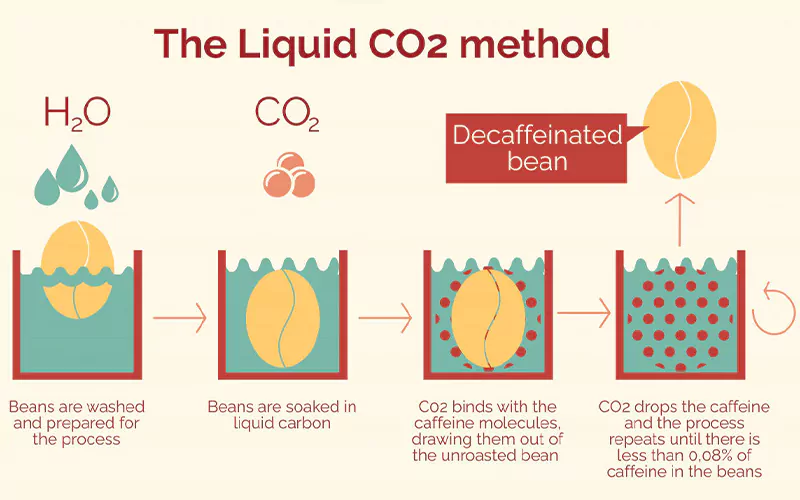
The CO2 method starts with green coffee beans. Workers steam the beans to open their pores. This step helps the beans get ready for caffeine removal. Next, they place the beans in a special chamber. Here, carbon dioxide is pumped in at very high pressure—sometimes up to 300 atmospheres. At this pressure and a warm temperature, CO2 becomes “supercritical.” In this state, it acts like both a gas and a liquid. The supercritical CO2 moves through the beans, grabbing caffeine molecules and pulling them out. After about ten hours, the pressure drops. The CO2 releases the caffeine, which gets filtered out. The CO2 can then be reused for the next batch.
Fun Fact: The CO2 method can remove up to 99% of the caffeine while keeping most of the bean’s natural flavors.
Supercritical CO2 Science
Supercritical CO2 is a unique form of carbon dioxide. It has the ability to flow like a gas but dissolve substances like a liquid. This makes it a powerful and selective solvent for caffeine. When used in decaffeination, supercritical CO2 targets caffeine molecules without disturbing the delicate flavor compounds in the beans. Scientists have found that this process can even cause some chemical changes in the beans, such as the formation of melanoidins. These compounds are usually created during roasting and may have health benefits, like reducing inflammation. The process also allows for recycling CO2, making it efficient and environmentally friendly.
Quality
The CO2 method stands out for its gentle approach. It preserves the integrity of the coffee bean and keeps the original flavors and aromas almost untouched. Unlike solvent-based methods, it does not leave behind chemical residues. Many specialty coffee producers prefer this method because it delivers a cup that tastes very close to regular coffee. The process is also sustainable, thanks to its closed-loop system that recycles CO2. Compared to other methods, the CO2 process is precise and maintains the body and delicate notes of high-quality coffee. This makes it a top choice for those who want the best decaf experience.
Decaf Coffee Beans Packaging by BN PACK
Importance of Packaging
Packaging plays a huge role in keeping Decaf Coffee Beans fresh and flavorful. After decaffeination, these beans become more porous, which makes them even more sensitive to air, moisture, light, and heat. If beans get exposed to oxygen, they lose their aroma and taste quickly. Moisture can cause mold or make the beans stale. Light and heat break down the natural oils that give coffee its rich flavor.
Good packaging acts like a shield. Multi-layered films with aluminum or metallized barriers block out oxygen and moisture. Opaque materials keep light away, while airtight seals and degassing valves let carbon dioxide escape without letting air in. Resealable pouches help keep beans fresh after opening. During shipping, sturdy packaging protects beans from breaking or getting contaminated. Storing coffee in a cool, dry place also helps, but packaging does most of the heavy lifting to lock in quality.
Tip: Decaf Coffee Beans need extra protection because they can go stale faster than regular beans. Always look for packaging that feels sturdy and seals tightly.
BN PACK Solutions
BN PACK stands out as a leader in flexible coffee packaging. The company uses advanced materials and designs to keep coffee at its best from the factory to your cup. Their packaging solutions include stand-up pouches, flat-bottom bags, and side gusset pouches, all designed to block out air, moisture, and light. Many of their products feature degassing valves and resealable zippers for added freshness.
BN PACK also cares about the planet. They offer eco-friendly options like biodegradable, compostable, and recyclable materials. Their packaging meets strict international safety standards and supports brands that want to reduce their carbon footprint. For example, some of the latest innovations in coffee packaging use recyclable aluminum pods, molded pulp containers, and paper-based canisters made from FSC-certified fiber. These options cut down on plastic use and lower emissions during shipping.
BN PACK Coffee Packaging Features | Benefits for Decaf Coffee Beans |
|---|---|
Multi-layer barrier films | Blocks oxygen, moisture, and light |
Degassing valves | Preserves aroma, prevents staleness |
Resealable closures | Maintains freshness after opening |
Eco-friendly materials | Supports sustainability goals |
Custom printing & design | Enhances shelf appeal and brand identity |
BN PACK’s expertise ensures that every bag of decaf arrives fresh, safe, and ready to brew. Their commitment to quality and sustainability helps coffee brands deliver the best possible experience to their customers.
Comparing Methods
Pros and Cons
Every decaffeination method has its own strengths and weaknesses. Here’s a quick look at how they stack up:
Decaffeination Method | Advantages | Disadvantages |
|---|---|---|
Solvent Extraction | Effective caffeine removal; fast process | Uses organic solvents; possible chemical residue; needs careful regulation |
Swiss Water Process | Uses only water; chemical-free; preserves more flavor; eco-friendly | Can slightly dilute flavor; uses more water and energy |
Supercritical CO2 | No chemical solvents; excellent flavor preservation; eco-friendly | Expensive equipment; slower process; higher cost |
Sugarcane Process | Uses natural ethyl acetate; adds subtle sweetness; more natural appeal | Can still change flavor; not always available everywhere |
Most methods remove caffeine well, but the way they affect taste and safety can differ. Regulatory agencies like the FDA set strict limits on solvent residues, so even solvent-based decaf is considered safe for most people.
Flavor Results
The decaffeination process changes the way coffee tastes, smells, and feels. The Swiss Water Process stands out for keeping natural oils and flavors, giving a clean and balanced cup. The CO2 method also does a great job, keeping the original taste and complexity, which is perfect for high-quality beans. Solvent-based methods, like ethyl acetate or methylene chloride, can sometimes leave a flat or slightly chemical aftertaste. The sugarcane process, while natural, may add a hint of sweetness but can still change the original flavor.
Consumer taste tests often rate Swiss Water Process decaf as the best for flavor. People notice a smoother, richer taste without any chemical notes. Solvent-based decaf sometimes tastes dull or lifeless, especially if lower-quality beans are used. Overall, all decaf methods reduce some flavor depth, aroma, and body, but water and CO2 methods do the best job of keeping coffee’s natural character.
Choosing the Best
Picking the right decaf coffee depends on what matters most to the drinker. Here are some tips to help with the choice:
Look for methods like Swiss Water or CO2 if flavor and natural processing are important.
Choose water-based decaf for a chemical-free cup and better environmental impact.
Consider solvent-based decaf if cost is a big factor, but check for brands that follow strict safety standards.
Think about roast level and bean origin—these affect taste as much as the decaf process.
Check for certifications like organic or fair trade for added peace of mind.
Read reviews and try different brands to find the flavor profile you enjoy most.
Make sure the beans are packaged well to keep them fresh and tasty.
Tip: The best decaf is the one that matches your taste, health needs, and values. Don’t be afraid to experiment!
Decaf Coffee Beans come from several scientific methods, each with unique effects on taste and safety. Studies show all approved methods, from Swiss Water to CO2, keep coffee safe and healthy. Many people think decaf loses flavor or health benefits, but research proves otherwise. When picking decaf, they should check both the process and the packaging. Quality packaging, like that from BN PACK, helps keep beans fresh and tasty. Trying different decaf options helps everyone find their favorite cup.
FAQ
What does “decaf” really mean?
Decaf means the coffee beans have had most of their caffeine removed. They still taste like regular coffee but contain only a small amount of caffeine—usually less than 3% of the original content.
Is decaf coffee safe to drink every day?
Yes, decaf coffee is safe for daily drinking. Food safety agencies set strict rules for decaf production. Most people can enjoy several cups a day without worry.
Does decaf coffee taste different from regular coffee?
Decaf coffee can taste a little different. Some methods keep more flavor than others. The Swiss Water and CO2 processes usually preserve the most natural taste.
How does packaging affect decaf coffee beans?
Good packaging keeps decaf beans fresh and flavorful. BN PACK uses special materials to block air, moisture, and light. This helps the beans stay tasty longer and protects them during shipping.
Can people with caffeine sensitivity drink decaf coffee?
People with caffeine sensitivity often choose decaf. Decaf still has a tiny bit of caffeine, so those who are very sensitive should check labels or ask the roaster for details.